Best Seller Icon Bestseller

Bachelor of Library Science- B.Lib.(M-BLS-8577)

  • Last updated Nov, 2026
  • Certified Course
₹15,500 ₹23,500

Course Includes

  • Duration1 Year
  • Enrolled0
  • Lectures215
  • Videos0
  • Notes0
  • CertificateYes

What you'll learn

Bachelor of Library Science (B.Lib.) — 1 Year


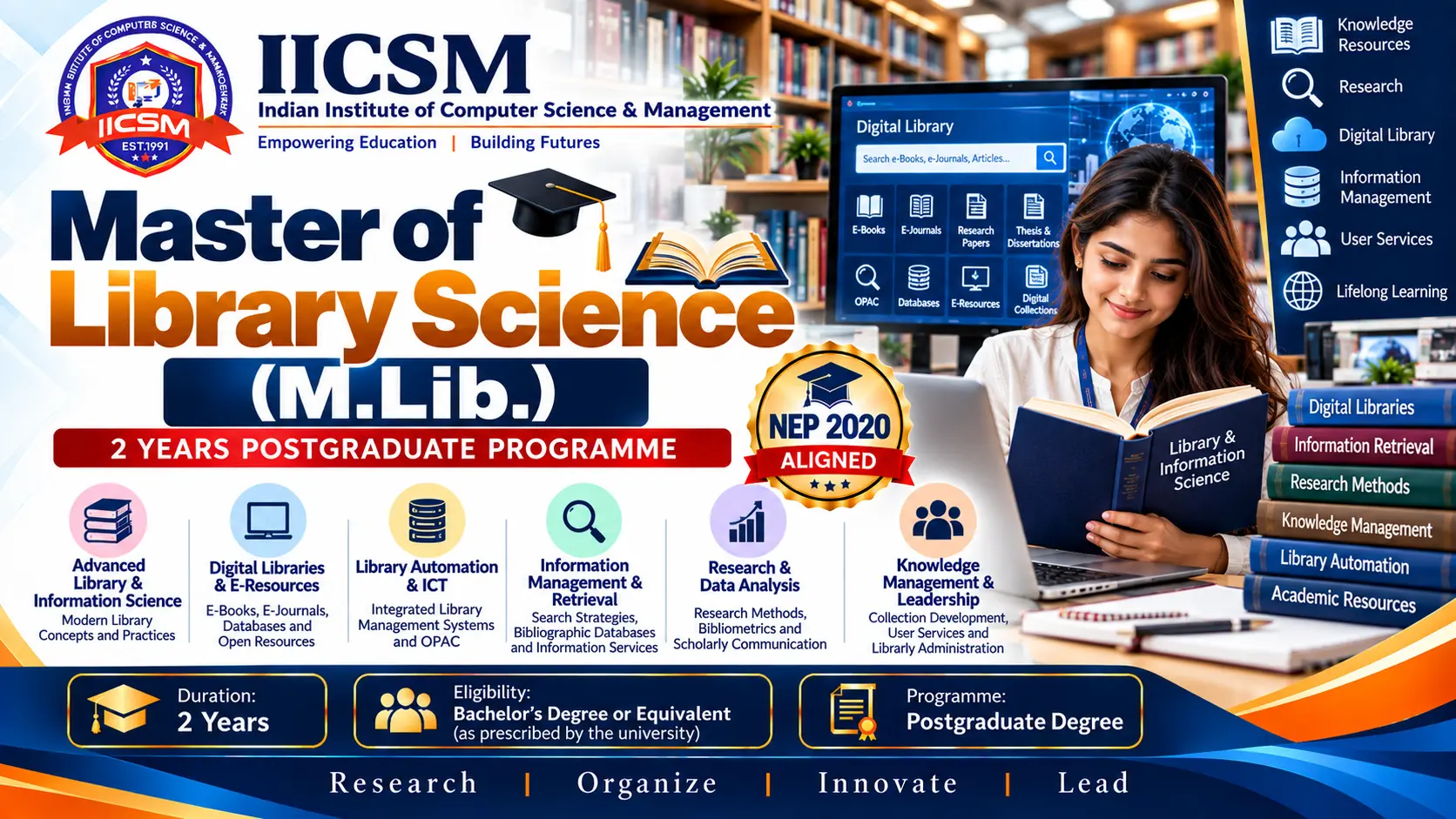
The Bachelor of Library Science (B.Lib.) as a professional programme in Library & Information Science, combining traditional librarianship with digital libraries, ICT, information management, research skills and library automation.

The proposed structure follows the broad NEP 2020 principles of multidisciplinary learning, digital literacy, practical/field-based learning, research, communication and employability. NEP 2020 specifically emphasizes flexible curricula, experiential learning, research and internships in higher education.

Regulatory note: A 1-year B.Lib./B.Lib.I.Sc. is commonly structured as a professional post-graduate-entry programme in India. Therefore, IICSM should use theexact nomenclature, eligibility, credits, duration and award title prescribed by its degree-awarding/affiliating university. The image accordingly states graduation/equivalent eligibility. NEP 2020 alignment alone does not establish degree recognition.

Programme Details

  • Programme Name: Bachelor of Library Science
  • Abbreviation: B.Lib. / B.Lib.I.Sc.
  • Duration: 1 Year
  • Structure: 2 Semesters
  • Programme Area: Library & Information Science:
  • Eligibility: Graduation or equivalent*, as prescribed by the university
  • Learning Mode: Theory + Practical + Field Training + Project
  • Academic Approach: NEP 2020-oriented
  • Major Focus: Library Management, Information Science & Digital Libraries

UGC's Learning Outcomes-based Curriculum Framework emphasizes knowledge, transferable skills, digital literacy, research and practical learning, while UGC's undergraduate framework promotes flexible and multidisciplinary learning.


Course Description

The Bachelor of Library Science (B.Lib.) is a one-year professional programme designed to prepare students for the modern library and information environment.

The programme develops competencies in:

  • Library Management
  • Library Classification
  • Cataloguing
  • Information Sources and Services
  • Reference Services
  • Library Automation
  • Digital Libraries
  • E-Library Resources
  • ICT Applications
  • Research Methodology
  • Information Retrieval
  • Knowledge Management
  • Library Networking
  • Documentation
  • Preservation and Conservation
  • Professional Communication

The curriculum combines traditional library practices with modern ICT-enabled information services, enabling learners to work effectively in academic, public, special, school, digital and institutional libraries.

UGC's model curriculum listings specifically include Library and Information Science among its model curriculum subject areas.


Programme Objectives

The programme aims to:

  1. Develop professional knowledge of library and information science.
  2. Understand the principles of library organization and management.
  3. Develop practical skills in classification and cataloguing.
  4. Train students in information sources and reference services.
  5. Develop competence in library automation and ICT applications.
  6. Introduce students to digital libraries and electronic resources.
  7. Develop information-literacy and information-retrieval skills.
  8. Develop research and documentation skills.
  9. Provide practical experience through library field training.
  10. Develop professional communication and user-service skills.
  11. Introduce students to knowledge management.
  12. Prepare students for careers in modern libraries and information centres.


Show More

Course Syllabus

B.Lib. Syllabus — 1 Year / 2 Semesters


Semester I — Foundations of Library & Information Science

  1. Foundations of Library & Information Science: Meaning, nature and scope of librarianship; history of libraries; five laws of library science; types of libraries; role of libraries in education and society
  2. Library Management: Principles of management; library organization; planning; staffing; budgeting; collection development; library rules; performance evaluation
  3. Information Sources & Services: Primary, secondary and tertiary sources; reference books; bibliographies; directories; encyclopedias; indexes; abstracts; information services
  4. Knowledge Organization – Classification: Classification concepts; notation; principles of classification; major classification schemes; practical classification exercises.
  5. Knowledge Organization – Cataloguing: Cataloguing principles; catalogue types; descriptive cataloguing; subject entries; metadata; electronic cataloguing concepts
  6. ICT in Libraries: Computers, operating systems, internet, databases, networking and ICT applications in libraries
  7. Practical-I: Classification, cataloguing and library ICT practical.


Practical Components

Students should practice:

  • Book classification
  • Shelf arrangement
  • Catalogue preparation
  • Accession register
  • Library membership records
  • Reference sources
  • Bibliography preparation
  • Internet information searching
  • Basic digital documentation


Semester II — Digital Libraries, Information Management & Professional Practice


  1. Library Automation: Automation concepts; integrated library systems; acquisition; cataloguing; circulation; serial control; OPACDigital Library & E-Resources: Digital libraries; institutional repositories; e-books; e-journals; databases; open educational resources; digital preservation
  2. Information Retrieval & Information Literacy: Search strategies; databases; online searching; Boolean operators; search engines; evaluation of information; information literacy
  3. Research Methodology & Statistics: Research concepts; research design; literature review; data collection; questionnaires; sampling; basic statistics; report writing
  4. Preservation & Conservation of Library Materials: Preservation principles; preventive conservation; digitization; disaster management; preservation of print and digital resources
  5. Knowledge Management & Information Services: Knowledge creation; knowledge sharing; organizational knowledge; documentation; current-awareness services; SDI
  6. Professional Communication & Library Services: User education; communication; public relations; reader advisory services; professional ethics.
  7. Field Training / Internship: Practical training in an academic/public/special/digital library.
  8. Project/Dissertation: Library/information science-based project.


Detailed Practical Training

The practical component should be a major feature of the programme.

Library Technical Work

Students can learn:

  • Accessioning
  • Classification
  • Cataloguing
  • Book processing
  • Spine-label preparation
  • Shelving
  • Stock verification
  • Circulation
  • Membership management
  • Serial control

Digital Library Skills

  • OPAC
  • E-books
  • E-journals
  • Online databases
  • Institutional repositories
  • Digital document management
  • Metadata
  • Information retrieval
  • Internet research

Library Automation

Students may receive practical exposure to an appropriate library management/automation system, subject to the resources and software adopted by the institution/university.

Eligibility

Who can apply for this course

Bachelor of Library Science (B.Lib.)

Duration: 1 Year

Eligibility: Graduation or Equivalent*

Programme: Library & Information Science

Structure: Theory + Practical + Field Training + Project

Course Fees

Course Fees
:
₹23500/-
Discounted Fees
:
₹ 15500/-
Course Duration
:
1 Year

Review

0.0
Course Rating (0 reviews)
0%
0%
0%
0%
0%


Call
Text Message
Review
Email
CHAT