Best Seller Icon Bestseller

BACHELOR OF BUSINESSE ADMINISTRATION(M-BBA-8398)

  • Last updated Oct, 2026
  • Certified Course
₹15,500 ₹23,500

Course Includes

  • Duration3 Years
  • Enrolled0
  • Lectures640
  • Videos0
  • Notes0
  • CertificateYes

What you'll learn

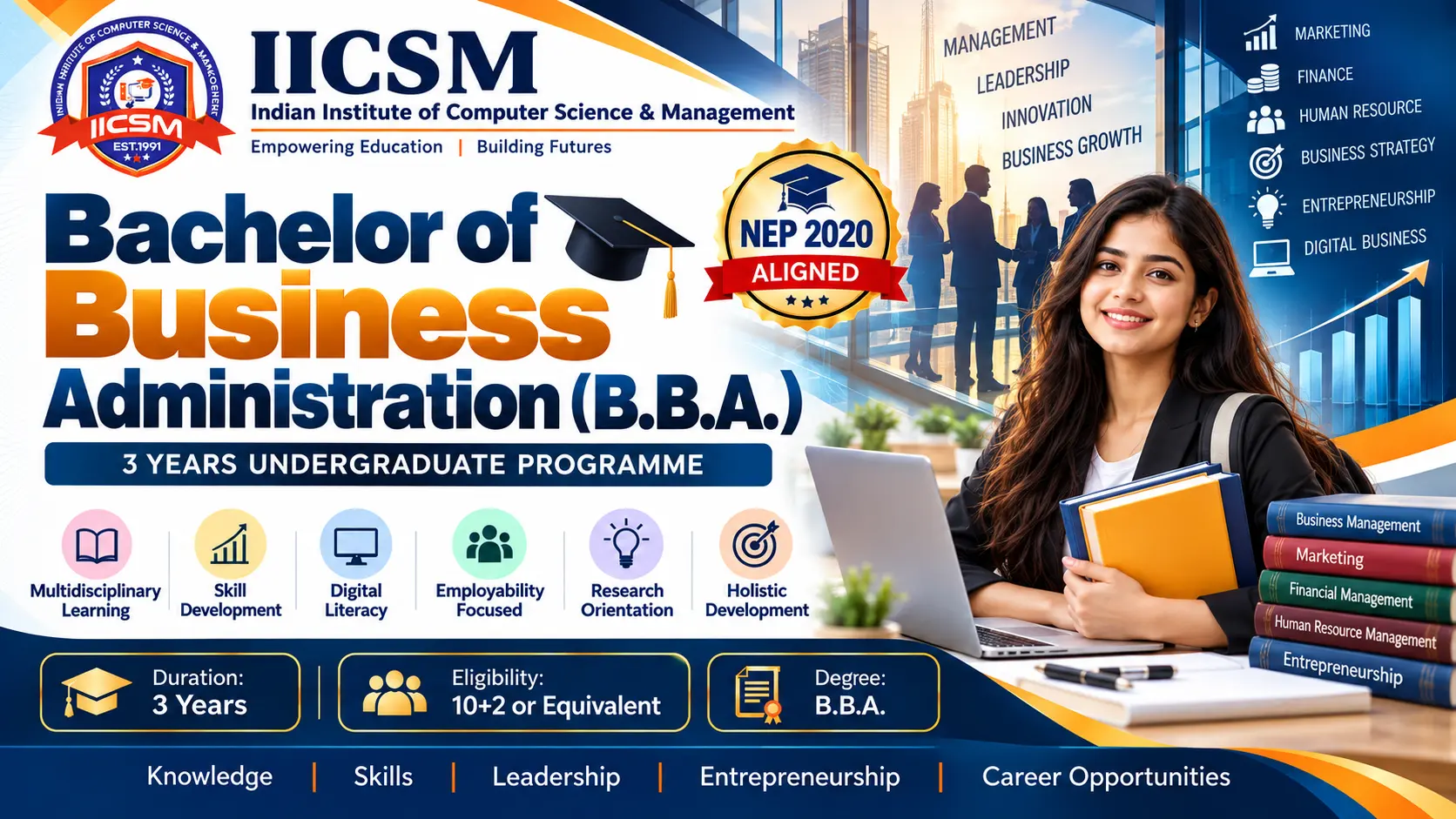
Bachelor of Business Administration (B.B.A.) – 3 Year Programme


NEP 2020 Aligned Undergraduate Programme

Course Description

The Bachelor of Business Administration (B.B.A.) is a three-year undergraduate programme designed to develop students' knowledge and practical competencies in management, business administration, accounting, finance, marketing, human resource management, entrepreneurship and digital business.

The programme is structured in the spirit of NEP 2020, emphasizing multidisciplinary learning, skill development, experiential education, internships, research orientation, entrepreneurship, digital literacy and holistic development. NEP 2020 specifically promotes flexible undergraduate curricula, multidisciplinary education, vocational/skill integration, internships with industry and opportunities for research and community engagement.

For IICSM, the final redit structure, major/minor combination, subject codes, examination pattern and degree-awarding authority should be aligned with the regulations of the university through which the B.B.A. degree is actually awarded.


UGC's undergraduate framework emphasizes a student-centric, flexible, multidisciplinary and choice-based approach, consistent with NEP 2020.


2. Programme Objectives

The B.B.A. programme aims to:

  1. Develop fundamental knowledge of business and management.
  2. Build managerial and leadership competencies.
  3. Develop accounting and financial literacy.
  4. Provide practical knowledge of marketing and sales.
  5. Develop human resource management skills.
  6. Promote entrepreneurship and innovation.
  7. Develop digital business and technology competencies.
  8. Build communication, teamwork and decision-making skills.
  9. Develop research and analytical abilities.
  10. Prepare students for employment, higher education and entrepreneurship.


3. Major Areas of Study

The programme may include:

  • Principles of Management
  • Business Economics
  • Financial Accounting
  • Business Communication
  • Business Mathematics
  • Business Statistics
  • Marketing Management
  • Human Resource Management
  • Financial Management
  • Business Law
  • Entrepreneurship
  • Operations Management
  • Digital Marketing
  • E-Commerce
  • Business Analytics
  • Strategic Management
  • Research Methodology


Show More

Course Syllabus

SEMESTER – I

1. Principles of Management

Topics

  • Meaning and nature of management
  • Management functions
  • Planning
  • Organizing
  • Staffing
  • Directing
  • Coordination
  • Controlling
  • Management levels
  • Managerial skills
  • Contemporary management approaches

Learning Outcome

Students understand the fundamental principles and functions of management.


2. Business Organization & Management

  • Forms of business organization
  • Sole proprietorship
  • Partnership
  • Company
  • Cooperative organization
  • Public and private enterprises
  • Business objectives
  • Business environment
  • Corporate governance

3. Financial Accounting – I

  • Meaning of accounting
  • Accounting principles
  • Accounting concepts
  • Journal
  • Ledger
  • Cash book
  • Trial balance
  • Depreciation
  • Final accounts

Practical

  • Journal entries
  • Ledger preparation
  • Trial balance
  • Trading and Profit & Loss Account
  • Balance Sheet

4. Business Communication

  • Communication process
  • Types of communication
  • Barriers to communication
  • Listening skills
  • Speaking skills
  • Business correspondence
  • Email communication
  • Report writing
  • Presentation skills
  • Group discussion

5. Business Mathematics

  • Number system
  • Ratio and proportion
  • Percentage
  • Profit and loss
  • Simple and compound interest
  • Equations
  • Permutations and combinations
  • Basic matrices
  • Business applications

Skill Enhancement Course – I

Digital Literacy & Office Productivity

  • Computer fundamentals
  • MS Word
  • MS Excel
  • PowerPoint
  • Internet
  • Cloud applications
  • Cybersecurity awareness
  • Digital documentation

SEMESTER – II

1. Business Economics

  • Meaning and scope of economics
  • Demand and supply
  • Elasticity
  • Consumer behaviour
  • Production
  • Cost
  • Revenue
  • Market structures
  • Pricing
  • Indian business environment

2. Financial Accounting – II

  • Partnership accounts
  • Company accounts
  • Inventory valuation
  • Depreciation
  • Cash flow basics
  • Financial statement analysis

Practical

  • Accounting problems
  • Financial statements
  • Ratio calculations

3. Business Statistics

  • Meaning and importance of statistics
  • Collection of data
  • Classification
  • Tabulation
  • Mean
  • Median
  • Mode
  • Dispersion
  • Correlation
  • Introduction to regression
  • Graphical presentation

Practical

Students use spreadsheets for statistical calculations and charts.


4. Business Environment

  • Internal and external environment
  • Economic environment
  • Political environment
  • Social environment
  • Technological environment
  • Legal environment
  • Global business environment
  • Indian business ecosystem

5. Marketing Fundamentals

  • Meaning of marketing
  • Marketing concepts
  • Market segmentation
  • Targeting
  • Positioning
  • Consumer behaviour
  • Product
  • Price
  • Promotion
  • Distribution
  • Marketing mix

Skill Enhancement Course – II

Spreadsheet & Data Analysis

  • Excel formulas
  • Functions
  • Sorting and filtering
  • Charts
  • Pivot tables
  • Business reports
  • Basic data visualization

SEMESTER – III

1. Human Resource Management

  • HRM concepts
  • Human resource planning
  • Job analysis
  • Recruitment
  • Selection
  • Training
  • Performance appraisal
  • Compensation
  • Employee relations
  • Workplace ethics

2. Marketing Management

  • Product strategy
  • Branding
  • Packaging
  • Pricing strategy
  • Distribution
  • Promotion
  • Advertising
  • Sales management
  • Consumer behaviour
  • Digital marketing

3. Business Law

  • Introduction to business law
  • Contract
  • Offer and acceptance
  • Consideration
  • Capacity to contract
  • Sale of goods
  • Consumer protection
  • Partnership
  • Company-related legal awareness
  • Digital business/legal awareness

4. Financial Management

  • Financial management concepts
  • Financial planning
  • Sources of finance
  • Capital budgeting
  • Working capital
  • Cost of capital
  • Capital structure
  • Dividend decisions
  • Financial analysis

5. Minor / Generic Elective

Possible options:

  • Economics
  • Computer Applications
  • Psychology
  • Sociology
  • Entrepreneurship
  • Statistics
  • Digital Marketing

Skill Enhancement Course – III

Research Methodology

  • Meaning of research
  • Types of research
  • Research problem
  • Objectives
  • Research questions
  • Hypothesis
  • Research design
  • Sampling
  • Data collection
  • Questionnaire
  • Interview
  • Data analysis
  • Research ethics
  • Referencing

Practical

Students prepare a small business research project.


SEMESTER – IV

1. Operations & Supply Chain Management

  • Production management
  • Operations strategy
  • Production planning
  • Inventory management
  • Quality management
  • Supply chain fundamentals
  • Logistics
  • Procurement
  • Warehousing
  • Distribution

2. Organizational Behaviour

  • Individual behaviour
  • Personality
  • Motivation
  • Leadership
  • Group behaviour
  • Team building
  • Organizational culture
  • Conflict management
  • Stress management
  • Organizational change

3. Entrepreneurship Development

  • Entrepreneurship concepts
  • Entrepreneurial qualities
  • Business ideas
  • Opportunity identification
  • Innovation
  • Startup ecosystem
  • Business model
  • Business plan
  • Sources of finance
  • Government support
  • Social entrepreneurship

Practical

Business Idea Development Project


4. E-Commerce & Digital Business

  • E-commerce concepts
  • B2B
  • B2C
  • C2C
  • Digital payments
  • Online marketplaces
  • E-commerce logistics
  • Digital customer service
  • Cybersecurity
  • Data privacy
  • Digital business models

5. Financial Literacy & Investment Awareness

  • Personal finance
  • Banking
  • Savings
  • Investment concepts
  • Insurance
  • Financial planning
  • Digital banking
  • Risk awareness
  • Responsible financial behaviour

SEMESTER – V

1. Strategic Management

  • Strategic management concepts
  • Vision and mission
  • Environmental analysis
  • SWOT analysis
  • Competitive strategy
  • Business-level strategy
  • Corporate strategy
  • Strategic implementation
  • Strategic control

2. Business Analytics

  • Introduction to business analytics
  • Data-driven decision-making
  • Business data
  • Data cleaning
  • Descriptive analytics
  • Data visualization
  • Business dashboards
  • Introduction to predictive analytics
  • AI applications in business

Practical

  • Spreadsheet-based analysis
  • Business charts
  • Dashboard preparation
  • Business case analysis

3. Digital Marketing

  • Digital marketing concepts
  • Website marketing
  • Search Engine Optimization
  • Social media marketing
  • Content marketing
  • Email marketing
  • Online advertising
  • Digital branding
  • Web analytics
  • Digital customer engagement

4. Internship / Field Work

Students may undertake internship experience with:

  • Business organizations
  • Banks
  • Financial institutions
  • Marketing agencies
  • Retail organizations
  • Startups
  • NGOs
  • Educational organizations
  • Local enterprises

Internship Activities

  • Business observation
  • Office administration
  • Marketing activities
  • Customer interaction
  • Data handling
  • Documentation
  • Business report preparation

NEP 2020 explicitly promotes internships with local businesses and industry to connect classroom learning with practical experience and improve employability. Education Government India


SEMESTER – VI

1. International Business

  • Globalization
  • International trade
  • Global markets
  • Export and import
  • Foreign exchange awareness
  • International marketing
  • Global business strategies
  • Multinational corporations
  • Emerging global business trends

2. Strategic Human Resource Management

  • Strategic HRM
  • Talent management
  • Leadership development
  • Employee engagement
  • Performance management
  • HR analytics
  • Workplace diversity
  • Organizational development

3. Innovation & Startup Management

  • Innovation concepts
  • Design thinking
  • Startup development
  • Business model canvas
  • Market validation
  • Funding
  • Branding
  • Startup operations
  • Social innovation
  • Entrepreneurship ethics

4. Project / Dissertation

Students complete a supervised business research/project.

Suggested Projects

  • Consumer behaviour study
  • Digital marketing analysis
  • Local business case study
  • Startup feasibility study
  • Employee satisfaction study
  • Retail market survey
  • Financial analysis of a business
  • E-commerce business plan
  • Social entrepreneurship project

Project Structure

  1. Introduction
  2. Review of literature
  3. Research problem
  4. Objectives
  5. Methodology
  6. Data collection
  7. Data analysis
  8. Findings
  9. Recommendations
  10. Conclusion
  11. References
  12. Viva/Presentation

Skill Enhancement Course – IV

Artificial Intelligence & Future Business Skills

  • AI fundamentals
  • Generative AI awareness
  • AI in marketing
  • AI in HR
  • AI in finance
  • AI-powered productivity
  • Business analytics
  • Responsible AI
  • Data privacy
  • AI ethics


Eligibility

Who can apply for this course

  • Programme Name: Bachelor of Business Administration (B.B.A.)
  • Duration: 3 Years
  • Academic Structure: 6 Semesters
  • Eligibility: 10+2 / Intermediate or Equivalent
  • Learning Approach: Theory + Practical + Project + Internship
  • MediumHindi / English
  • Programme Type: Undergraduate Degree
  • Framework: NEP 2020 Aligned
  • Focus: Business, Management, Digital Skills & Entrepreneurship

UGC's undergraduate framework emphasizes a student-centric, flexible, multidisciplinary and choice-based approach, consistent with NEP 2020. 

Course Fees

Course Fees
:
₹23500/-
Discounted Fees
:
₹ 15500/-
Course Duration
:
3 Years

Review

0.0
Course Rating (0 reviews)
0%
0%
0%
0%
0%


Call
Text Message
Review
Email
CHAT